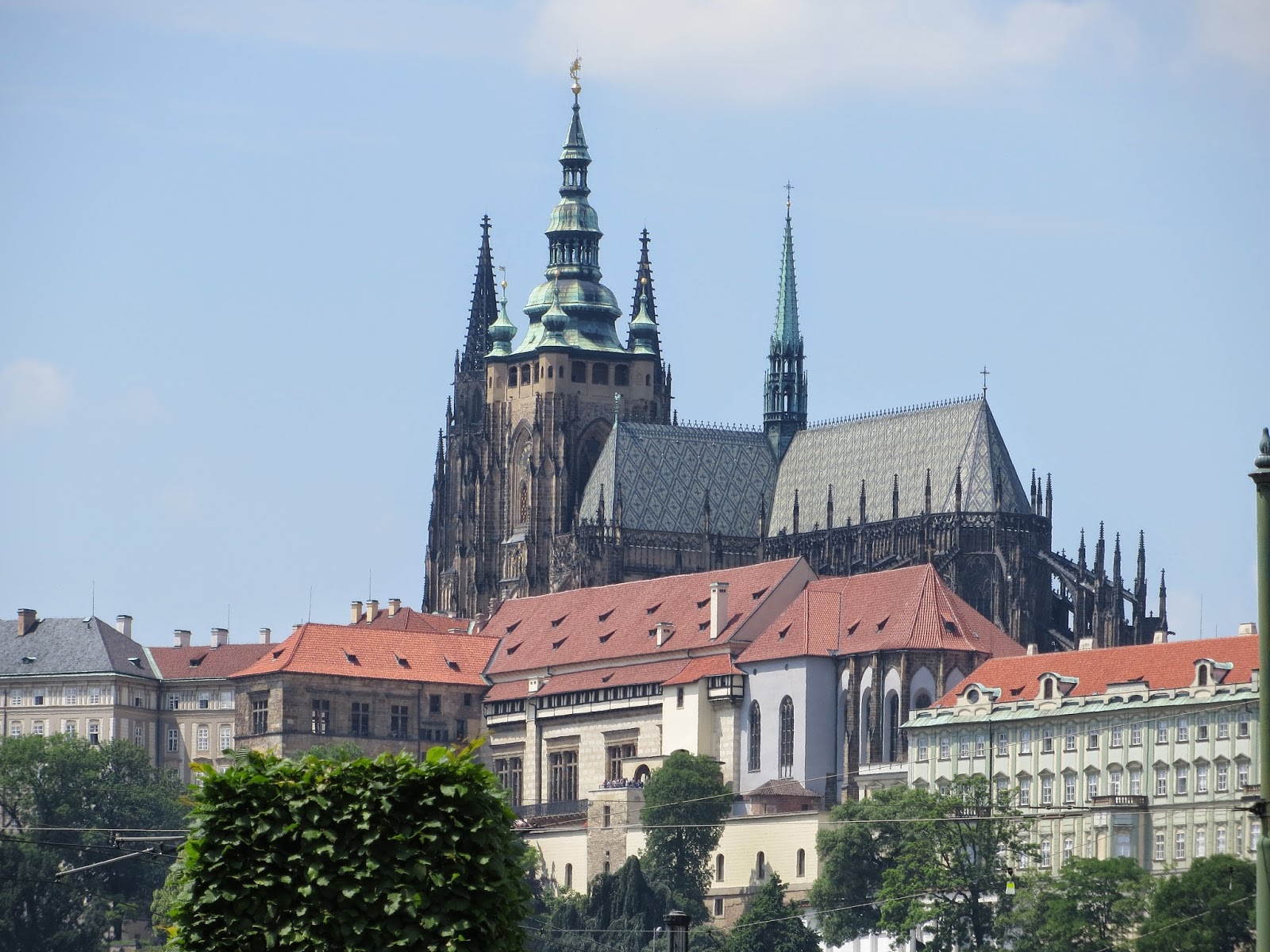
Dominating the skyline above the river is the Prague Castle.
The castle is said to be eleven football fields in size and is still the seat of the government today. The central building in the complex is St. Vitus Cathedral.
So following our walking tour we crossed the river and headed uphill. Along the way we had a stop for lunch at a lovely vineyard restaurant.
The local wines were surprisingly tasty as was the local cuisine. We ate, drank and rested a bit before heading upward.
Spying a large mirror for trafic viewing, we found a new way to take a selfie.
Much of the original wall surrounding the castle remains today.
The grounds include the castle, the cathedral, an old lane of original housing, another church and various smaller sites. As you enter the guards keep watch.
The most imposing part of the complex by far is the cathedral. The cathedral is the largest and most important church in the Czech Republic and contains the tombs of many Bohemian kings and Holy Roman Emperors. Construction was begun in 1344, and continued until it was finally finished nearly 600 years later in 1929.It is nearly impossible to get a full view photo of the cathedral due to it's size and the proximity of the surrounding building. But each of the elements is extraordinary in its own right.
The doorway with the mosaic of the Last Judgement over it is the entrance the kings and emperors used to enter for their coronations.
Upon entering, the height and magnitude of the cathedral can take your breath away.
As you begin to walk around this vast expanse, there is so much to see. Each of the stained glass windows is unique.
There are graves and shrines and statuary.
The pulpit itself is a work of art from every angle.
There are many saints, Kings and Emperors buried in the cathedral. The royal crypt is not open for public viewing, but there is still much to see.
There are old time confessionals.
And dozens of unique side altars ring the center apse.
Some of the areas we were not sure of, but most seemed to be tombs or tributes to the many who are buried here.
Within the cathedral is the court treasury where valuable jewels and artifacts are housed. It is open to the public every eight years. This was not an eighth year.
There are statues and altars made of silver and tributes made of stone.
There is a side chapel where the coronation of Kings and Emperors were held.
And of course the organ was most impressive.
And this is just a small sampling of what is housed in St. Vitus.
The castle itself is enormous and was built is stages. The old castle is available for touring with no photos allowed. Unlike many of the castles which are filled with gold and art and statuary, this castle is much older and it is large, cold and sparsely furnished. It was build long before what we generally think of when the term castle is used. The exterior is much newer but the interior and the furnishings are barely changed from the original.
After the castle we went to the King's Lane. At first glance it resembles Daigon Alley of Harry Potter fame.
This lane is line with original homes and shops. Though it now houses more modern fare, some of the houses are recreated to look like the former days.
And the doorways were low and interesting.
We left the castle grounds just as the changing of the guard was taking place.
And then it was off to find a small cafe where we could enjoy the view and rest our weary feet. Just outside the cafe we saw one of the most interesting fountains I have ever come across.
What made this fountain most interesting is the fact that from waist to thigh of each gentleman rotates from side to side. Lots of grins among the tourists here.
The cafe we found was on the river front with peaceful views.
After our respite and some local shopping, we began a walk along the riverfront toward dinner. The swans were much bigger on this part of the river.
Our walk took us past one of the most iconic pieces of modern architecture in Prague. It is a building designed by Vlado Milunk and American Frank Geary called Dancing House. The name is derived from its curved lines and feeling of movement. Locals call it Fred & Ginger.
We had dinner in a quiet little neighborhood pub and then headed back to put our very tired feet up. Tomorrow is another day.
One of the wonderful things about Prague (and there are many)is the fact that nearly everything you might want to see is within walking distance of the town center. So a walking tour led by a local seemed to be a great way to start our day. After breakfast, of course.
While waiting for the tour to begin, we wandered around Old Town Square checking out the old and beautiful architecture.
We also had a closer look at the astronomical clock.
The Prague Orloj (astronomical clock) is a medieval clock that was first installed in 1410. this makes it the third oldest astronomical clock in the world and the oldest one still working. In some ways the orloj is considered a primitive planetarium, displaying the current state of the universe. The description on all the information being displayed is quite extensive and interesting. The outermost ring even has a space for each day of the year. This is one of those things that you never tire of staring at. It is simply fascinating.
Our walk started on a street near our hotel that led us to Charles University. Founded in 1348, Charles university is one of the oldest universities in Europe in continuous operation. There are now many buildings but this is one of the oldest.
Next door is the Prague Opera House. It was the location of the premier of Wolfgang Amadeus Mozart's opera Don Giovani in 1787. It is considered one of his most important works and is part of the operatic repertoire even today. The inside of the opera house was not on tour, but you may have seen it in the movie Amadeus.
From there we walked on to Wenceslas Square. This area is more of a boulevard than a square and has been the sight of many historical events including the proclamation of the independence of Czechoslovakia in 1918, Nazi demonstrations, the Prague Uprising in 1948 and the takeover by the Soviets at the end of World War II.
Next we walked through one of the original gates that protected the city.
It was time for a break and we headed to a small brew house where we tasted the local specialty. We even passed a fire juggler along the way.
The young girl I am drinking with is Clara. She is a student from Brazil who is studying in London. She was taking a multi-city tour of the continent for her birthday.
We noticed as we walked around that many of the local businesses use celebrities in their names. There was the Bond Cafe.
And the James Dean Cafe.
Our tour then headed into the Jewish quarter. This area was rebuilt in the 1800's replacing the old homes and is very impressive today. It was not always so.
One of the most famous residents of the Prague Jewish Quarter was Franz Kafka. There is a very interesting statue honoring him.
Near this statue is the Spanish Synagogue. It is the site of the oldest synagogue in Prague but the original was demolished in 1867 and replaced by the Spanish Synagogue. It is said that the architecture was a tribute to the Moors who lived side by side with the Spanish Jews.
There were some very interesting facades along the way.
On a high hill there is a huge metronome in tribute to Mozart. We were told it replaced a 30 meter statue of Stalin that was erected during the Soviet occupation. It was quickly blasted away after.
In the midst of this area is the Old-New Synagogue. We were told that it is the oldest active synagogue in the world. It was completed in 1270 and is one of Prague's first Gothic buildings.
Next to the Old-New Synagogue is the Jewish Town Hall. It is noted for its clock which is numbered according to the Hebrew alphabet and the hands run counter-clockwise. Oh, and the small hand indicates minutes while the longer hand gives the hour. It's a true talent to tell time on this clock. To keep it simple, there is a traditional clock on the upper tower.
One of the most interesting sights in the Jewish Quarter is the cemetery. During former times when the Jews were confined to the Quarter, there was only a small area set aside for a cemetery. When it was filled the grave stones were lifted and a layer of soil was added for a new layer of graves. The old stones were put in place and new ones were added. This happened until there were 12 layers of graves and over 300,000 souls buried in this space. It is quite elevated and quite hidden from general view.
At the end of the tour we were by the Jewish museum where records are kept of all the families lost in the Holocaust. We were told that until she visited this site, Madeline Albright (former US Secretary of State) had no idea her ancestors were Jewish.
The tour was three hours of exploration and history and it was a great way to learn about this beautiful place.